

Turn infrastructure data into defensible financial decisions.
From Claude, ChatGPT, or Copilot, turn BoMs, renewals, suppliers, and assets into business cases traceable to source.
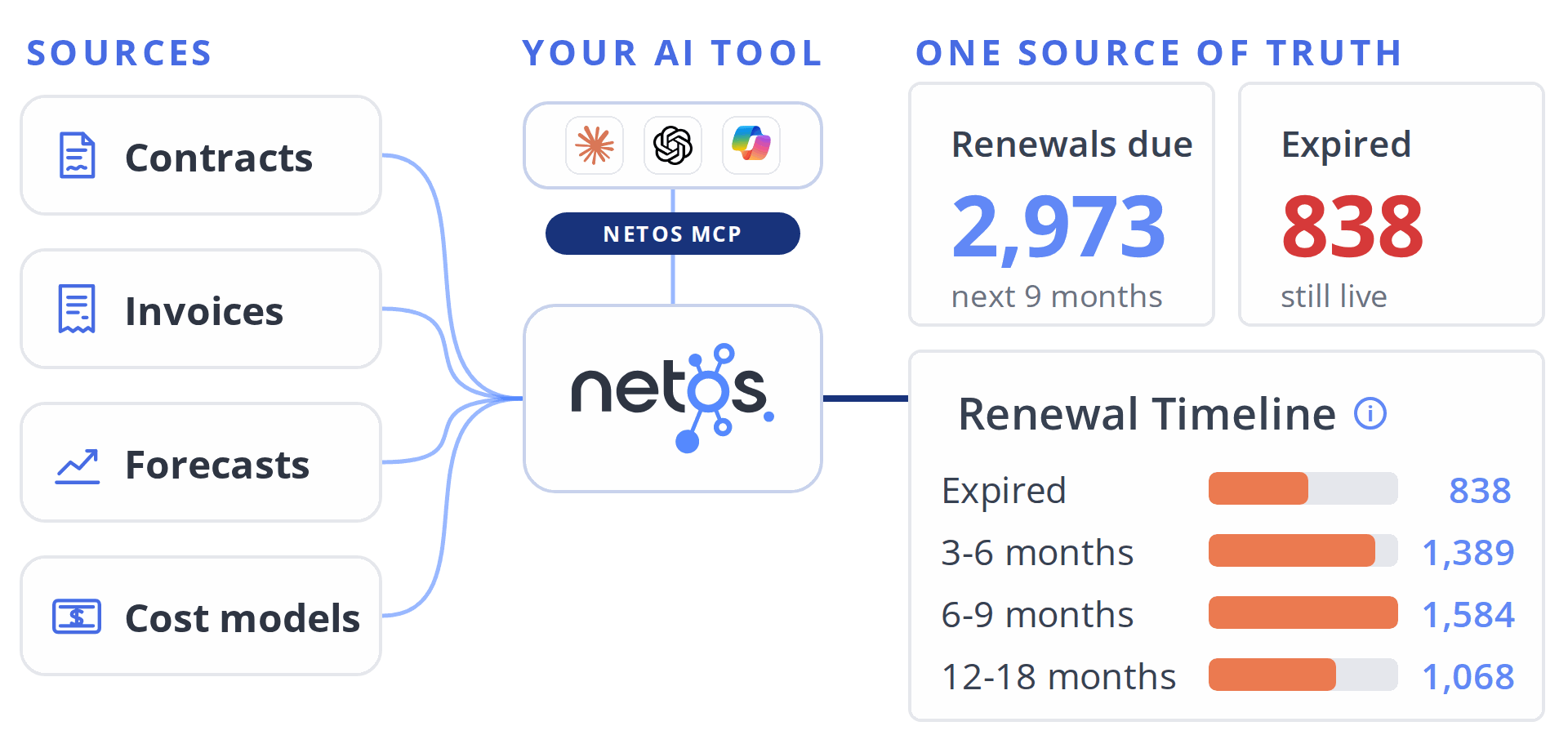
Invoices, BoMs, contracts, and renewals rarely line up.
Network spend is difficult to manage because invoices, BoMs, contracts, assets, renewals, and supplier pricing rarely line up cleanly.
The Finance Playbook helps connect those sources so finance, procurement, and network leadership can work from the same evidence base.
Built for finance.
Built for
Finance leaders, procurement, IT finance, VP Networks, commercial teams.
Delivers
Network inventory, BoMs, invoices, and renewals, turned into financial insight.
Inputs
BoMs, invoices, contracts, renewal data, supplier pricing, asset exports, project options.
Example workflows.
Three of the most common Finance Playbook jobs. Start with one.
BoM to business case
Import a supplier BoM, map it to existing inventory, separate CapEx and OpEx, and produce a comparison against current baseline.
Renewal exposure
Identify upcoming renewals across support, licences, circuits, and contracts, then model budget exposure by quarter or year.
Supplier comparison
Compare supplier proposals against current estate, lifecycle risk, commercial assumptions, and target operating model.
What you get out.
- Cost models, CapEx and OpEx forecasts
- Renewal timelines and budget exposure
- Cost allocation and chargeback reports
- Supplier and vendor comparison packs
- Executive-ready business cases
Every output is sourced. Netos keeps the data model, the audit trail, and the assumptions behind each recommendation.
Reviewable by finance.
The Finance Playbook helps convert technical network data into financial outputs, not black-box recommendations. Every recommendation shows:
Source data used
Every line traces back to its origin, BoM, invoice, contract clause, or supplier quote, not a synthesised number.
Assumptions applied
Inflation, FX, discount rates, and contract terms shown alongside every result so reviewers can challenge them.
Cost classification
How each cost is categorised, network, support, circuit, software, and why it lands as CapEx or OpEx, with the policy that drove the call.
Known gaps
Records with missing fields, unmatched suppliers, or unverified assumptions are flagged on the output, not hidden.
Confidence level
A quality score on every recommendation, weighted by source data coverage and reconciliation status.
Recommended next action
One clear next step, approve, query, escalate, or request more data, so the review keeps moving.
How the Finance Playbook works with Netos.
The Finance Playbook runs from your own AI tool, Claude, ChatGPT, or Copilot, through Netos MCP. It works against the Netos platform: the data model, source of truth, analytics layer, reporting environment, and audit trail.
The playbook prepares cost models, renewal forecasts, and business cases, while your finance and network teams keep control of assumptions, review, and decisions.
What the Finance Playbook delivers
A defensible spend story, no more renewal surprises, faster path from BoM to business case.
- Contracts and SOWs
- Invoices and PO records
- BoMs and supplier exports
- Services and applications
- Inventory and lifecycle baseline
- Match invoices to contracts and assets
- Forecast renewal dates and amounts
- Compare supplier cost and exposure
- Model refresh and migration scenarios
- Build the business case narrative
- Renewal calendar
- Spend baseline
- Supplier comparison pack
- Business case pack
- Exception report (unmatched spend, contract gaps)
Explore AI Playbooks
Governed playbooks you run from your own AI tool, built on the Netos platform.
AI Playbooks
Your AI tool, Netos MCP, three playbooks.
BackgroundOur AI Journey
The lessons baked into the playbooks.
PlaybookData Playbook
Clean, reconciled inventory.
You are hereFinance Playbook
Cost models, renewals, business cases.
Next →Systems Playbook
Lifecycle, refresh, audit plans.
Continue the story →